
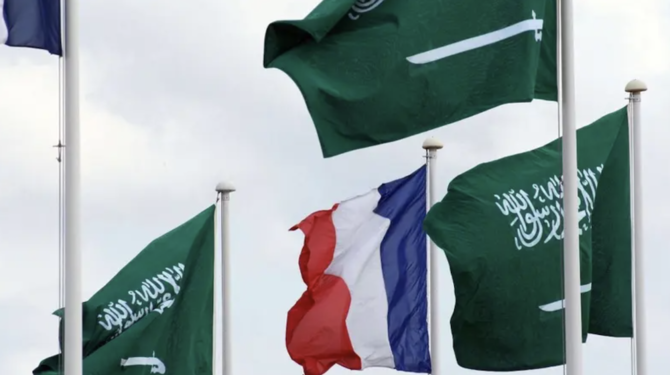
PARIS: French investment in Saudi Arabia is expanding beyond traditional sectors such as energy and manufacturing into artificial intelligence, digital infrastructure, culture, financial services and gaming, according to a briefing on the investment relationship between the two countries.
A report released on Monday, as Saudi Investment Minister Fahad Al-Saif chaired the French-Saudi Investment Roundtable Meeting in Paris, showed that France was Saudi Arabia’s fourth-largest source of foreign direct investment stock in 2024.
French investment reached about €16.3 billion ($19 billion) across 18 sectors and 651 investment licenses, double its level five years earlier.
The roundtable was held during the visit of Saudi Crown Prince and Prime Minister Mohammed bin Salman to France, bringing together senior government officials, business leaders and chief executives from major companies in both countries.
Al-Saif said the two countries’ relationship, which dates back a century, reflected a strong alignment between French capabilities in technology, industry, finance and innovation and the ambitions of Saudi Vision 2030.
This section contains relevant reference points, placed in (Opinion field)
Manufacturing accounts for about 60 percent of French investment stock in the Kingdom, reflecting the long-standing industrial ties between the two countries. Major French companies operating in Saudi Arabia include TotalEnergies, AXA, EDF, Accor and Thales.
However, the investment relationship is increasingly expanding into emerging sectors as Saudi Arabia pursues economic diversification under Vision 2030.
Al-Saif said the transformation had helped make Saudi Arabia one of the fastest-growing economies in the G20, with GDP expanding by about 85 percent since 2017, from approximately €620 billion to €1.1 trillion last year. Non-oil activities now account for more than half of GDP, while investment has become a major driver of economic growth and diversification.
Foreign direct investment inflows reached approximately €6.1 billion in the first quarter of 2026, an increase of 2.4 percent from the same period a year earlier, he said.
The report found that the two countries recorded bilateral trade of about €10.1 billion in 2025, an increase of 7.2 percent from the previous year.
French companies are now exploring opportunities in AI and digital infrastructure, alongside established areas including energy, water, transport and logistics, construction, hospitality and healthcare.
Saudi Arabia ranked first globally in the International Telecommunication Union’s 2025 ICT Development Index, while its digital economy accounted for about 16 percent of GDP in 2024. The Kingdom is targeting up to 3 gigawatts of AI infrastructure capacity by 2030.
Data center capacity has reached 440 megawatts, supported by more than €3.85 billion in investment, while announced AI partnerships have exceeded €19.7 billion. Oracle and Google Cloud have launched cloud regions in the Kingdom, with Amazon Web Services and Microsoft also scheduled to launch operations in 2026.
The roundtable identified building the digital economy through AI and digital infrastructure as one of four key areas for deeper cooperation. Other priorities included financing transformative destinations, turning industrial partnerships into executable projects, and advancing transportation and logistics to strengthen economic integration.
Financial services represent another potential growth area. Saudi Arabia has opened its main stock market to all foreign investors, while the Saudi Exchange, or Tadawul, remains the largest and most liquid equity market in the Middle East and North Africa.
As the Saudi economy expands, financial services and insurance are expected to benefit from growth in priority sectors, creating opportunities for new investors as well as mergers and acquisitions.
Gaming and esports are also emerging as new areas for French investment. Al-Saif said average revenue generated per player in Saudi Arabia was around 7 percent above the global average and approximately 4.5 times the average in the Middle East and Africa.
The Kingdom’s young and highly engaged market, he said, offered opportunities to develop Saudi intellectual property, produce content and create specialized jobs, while building companies capable of competing internationally.
The energy sector remains a major area of cooperation, with French-company projects in the Kingdom exceeding €16.3 billion. French-led consortia are also participating in solar projects with a combined capacity of 11 GW, while investment opportunities are expanding into renewables, energy storage, hydrogen and grid infrastructure.
Saudi-French cooperation in oil and gas already extends across conventional energy and petrochemicals, while French companies are increasingly involved in the Kingdom’s transition toward cleaner energy.
French companies are also deepening their involvement in Saudi Arabia’s tourism and cultural sectors. The Saudi-French partnership in AlUla has generated more than 170 contracts for French companies, while hospitality group Accor continues to expand its presence across the Kingdom.
French Economy and Finance Minister Roland Lescure emphasized the importance of the strategic partnership, particularly in energy and logistics security. He said Saudi Arabia had demonstrated its reliability in maintaining the stability of global energy markets and played an important role connecting the Middle East and Europe in energy and logistics.
Lescure also highlighted the convergence between Saudi Vision 2030 and France 2030, saying the role of French companies in Saudi Arabia was increasingly moving beyond selling products and services toward co-production and long-term partnerships.
The investment relationship has also grown in the opposite direction, with Saudi Arabia’s Public Investment Fund investing about €7.36 billion in France between 2017 and 2024, supporting an estimated 29,000 French jobs.
A memorandum of understanding between the PIF and Bpifrance, valued at about €8.56 billion, provides a framework for further investment cooperation. The opening of a PIF office in Paris has also been presented as a step toward attracting greater Saudi investment into France.
Qiddiya Investment Company and the French government are exploring cooperation on the development of a major destination combining entertainment, sport and culture in France, according to the briefing.
The report noted that the broader economic relationship is underpinned by a century of diplomatic ties dating back to 1926. The two countries signed a Comprehensive Strategic Partnership and established a Strategic Partnership Council during a state visit in December 2024, opening new avenues for cooperation.
Saudi Arabia is also seeking to attract more international investment through regulatory reforms and incentives, including its updated Investment Law, Special Economic Zones and the Regional Headquarters Program.
Al-Saif noted in his opening address that more than 750 companies had established regional headquarters in Riyadh, including 39 French companies across eight sectors. Qualifying companies can benefit from tax incentives for up to 30 years under the program.
He said the Cabinet’s recent approval relating to offshore financial activities would further strengthen the Kingdom’s position as a platform from which international companies can manage their regional operations.
The Kingdom’s industrial expansion is another area in which French companies see opportunities. The number of factories reached 12,946 by the end of 2025, while 1,660 new industrial licenses were issued during the year, representing investments of about €17.1 billion.
The briefing said Saudi Arabia’s large domestic market, expanding industrial base, infrastructure development and policy stability were creating opportunities for French companies to establish operations in the Kingdom and use it as a platform for wider regional growth.
French investment stock has doubled over the past five years, with companies including TotalEnergies, Alstom, RATP Dev, Veolia and Accor continuing to expand their operations.
The investment relationship comes as Saudi Arabia seeks to attract around €2.74 trillion in investment by 2030 under its National Investment Strategy, with opportunities identified across more than 15 sectors.
As Vision 2030 enters its final implementation phase, the overlap between France’s strengths in technology, industry, finance and innovation and Saudi Arabia’s investment priorities is expected to create further opportunities for deeper, longer-term partnerships.